
Short Story: "Treading Eggshells" from Weird Wilderness
While tracking an endangered bear cub in the Gobi Desert, a biologist fights for his life against a creature that should not exist

This short story was originally published in the anthology Weird Wilderness: A Cryptid Bestiary from Wordfire Press.
I highly recommend the whole book, not because I’m published in it, but for its array of legendary creatures and authors who know how to tell a great story. Bigfoot, Mothman, Nessie, and loads of other cryptids are featured! Plenty of laughs, tears, and amazement wait between those pages.

TREADING EGGSHELLS, by John K. Patterson
Flaming Cliffs, Mongolia - 460 km southwest from Ulaanbaatar
Dr. Dominic Alderidge kept one hand on the Delica’s steering wheel and pounded back his last energy drink, driving up to the fossil dig site at the base of the cliff. His standard diet of steamed mutton and dumplings wouldn’t be enough for a night like this, and that was normally the best fuel he could get on the edge of the Gobi Desert. He’d been saving the fluorescent green can for an emergency.
Tonight qualified. Someone had shot one of the bears he’d been tracking. And he needed to rescue her cub if he could.
A scattered crew of locals and sunburned grad students chipped away at rocks or navigated the grid of stakes set up over the site, only a few approaching to greet Dominic as he pulled up the 4x4 minivan alongside their pickup trucks. He crushed the now-empty can, grabbing a thermos of hot water for his daily peppermint tea. He’d splurged on a good thermos, so it would still be hot when night fell.
The nearest figure came up to greet him, a Black man in his fifties or sixties with close-cropped white hair. His cargo pants and black shirt had been officially baptized in the dust of the Gobi.
“You’re head of operations, I presume?” Dominic asked.
“Correct,” the man said as he extended a hand. They shook. “Kirk Berg, paleoecologist. Your bear is a hundred yards north from the site. I’ll take you.”
They passed a trio of folding tables where some fossils were collected, many of them encased in plaster and aluminum foil. Bones and teeth were set around a large centerpiece: a clutch of white eggs, still set in reddish sandstone as if prepared for a museum exhibit.
“Thanks for calling me,” Dominic said. “Are those dinosaur eggs?”
Berg nodded. “Protoceratops. Like a Triceratops but with no horns, about the size of a German Shepherd. We’ve found thousands of eggs! Even more than Andrews found here back in the 1920s—”
“I’d love to hear more about it later, but we’re running out of time.”
“Just excited, is all,” Berg said with a grin. “At least you were close by, thank God. I expected you’d be in the capital, not in the field.”
“I’ve been tracking this bear’s mother to the south.” By now, Dominic was well acquainted with Ursus arctos gobiensis, the Gobi Brown Bear. The subspecies was the only bear adapted for life in the deep desert, not to mention the rarest in the world, with only thirty-one known individuals. Though their population was recovering, each death was a steep step backward.
Dr. Berg led him to a furry brown shape rising above the dry bushes. The mother.
Dominic tucked his thermos under his arm, bending down to examine the body. Aside from the three bullet holes and accompanying blood, there was nothing out of the ordinary.
Now that this was more than just a phone call, now that the animal lay dead at his feet, his knees wobbled, and his eyes misted over.
One step closer to extinction. But at least you had a child. He made a silent promise to her that he would protect her cub.
“Cub’s still out there?” he asked.
“Yes,” Dr. Berg said. “One of our guides had to shoot the mother. The cub was following her at a distance. It took off before we could grab it.”
The sun raced to the horizon. Dominic couldn’t spare much time, but he could conduct an autopsy in the morning. “How was she acting?” he asked. “You told me over the phone it was self-defense. She was aggressive?”
“Extremely. Snarling and twitching like someone hit her with a cattle prod.” He paused, closing his eyes for a moment. “We could tell she was in pain. Maybe poisoned. Got way too close to one of my students. Then bang.” Berg used his hands to mimic holding a rifle.
Dominic scratched his beard. “Poisoned? That rules out poachers.” Mongolia had few cases of bear poaching, none of which involved poison.
“You’re thinking a wild source, then?” Berg asked, wiping his forehead with a handkerchief. “Ate something that didn’t agree with her?”
“Could be. Or brain damage, or an infection. But that can wait.” The orphaned cub would be only a few months old, defenseless against hungry snow leopards or golden eagles. “You got a tracker?”
“Our shooter volunteered,” Dr. Berg said. He waved up a figure in a green windbreaker who had been standing next to the dig site, leaning on a dirt bike painted red and blue. “Baatar’s a good man. Best English speaker in the group. Ready when you are.”
Nodding, Dominic stepped forward as Baatar came up to meet them. The Mongolian man looked to be in his midthirties, about five years younger than Dominic and a few inches taller. He’d cut his hair shorter than most of the other locals helping at the dig site.
Dominic noted the Mosin-Nagant rifle strapped over his back. Baatar looked down at the bear, full of regret.
“I can use my bike,” he said with a strong accent. “Faster than horses. Faster than your Delica.” He aimed an accusatory finger toward the minivan.
Dominic nodded. “I don’t doubt it. But we’re going to need the van to transport the cub back, so we’ll have to bring both.”
“We’ll have a cot set up for when you get back,” Dr. Berg said.
#
Within an hour, the setting sun burned the clouds in the kind of spectacular display Dominic lived for. This was the unfiltered wild, out in the arid purity of Mongolia.
It took less than an hour for Baatar to track down the cub, and another ten minutes for Dominic to get the little guy calm enough to place him in a pet carrier, which now rode shotgun next to him. A little anticlimactic for his sense of adventure, but with the rarest bear on Earth, an uneventful rescue was always a cause for relief.
Hardly bigger than a terrier, the tiny bear called for its mother plaintively, but there was little Dominic could do until they got him to the shelter in Ulaanbaatar.
“Hang in there, little guy,” he said, gently patting the top of the carrier. “We’ll take care of you.”
Baatar accompanied him on his bike, heading back toward the fossil dig.
Without warning, Baatar veered off-course.
Frowning, Dominic turned the van to follow him. After ten seconds or so, Baatar stuck out a hand to wave him down and skidded his bike to a halt.
Putting the van in park, Dominic looked through the front of the carrier at the little cub. “Stay here, buddy.” He was getting cold, so he grabbed his thermos and took it with him.
“What’s wrong?” he asked Baatar.
The man crouched low to the ground. “I wondered,” he said quietly to himself. “Yes, here. I’m seeing the mother’s path.” He stepped forward, rifle slung over his shoulder.
Dominic could see many of the same faint details, having spent time with these bears before. The pattern of dry plants pressed or crushed by a heavy foot, a loose scattering of stones, a fingernail-sized clump of fur on a twig; if you didn’t know what to look for, it would be easy to miss. They must have been only a few minutes from the dig site now.
“You saw this from your bike?”
“I saw a hole in the ground—up there.” Baatar pointed. “Had a hunch she’d been through here. There might be a clue about what poisoned her.”
“Assuming she was poisoned.”
He followed Baatar, rocks tripping him up. The desert quickly lost its heat, and Dominic grew nervous. He didn’t want to be here for the nighttime winds.
The dry desert plants had concealed a small hole in the ground, about a meter in diameter. Dominic was impressed that Baatar had seen it from his motorbike. They were about twenty meters away from it when Baatar skidded to a halt, falling backward. Dominic helped him back to his feet.
The man shouted something in Mongolian. “We have to leave. I shouldn’t have checked! We have to go.”
“Baatar? What are you panicked about?”
“Olgoi-khorkhoi! Now I know what happened to the mother!”
“Olgoi—” Dominic started to repeat the name, then it registered. He had heard of it, and though he’d only met Baatar today, he still felt a deep exasperation rise in his gut. The man should have known better. Olgoi-khorkhoi loosely translated as “intestine worm,” a fabled wormlike creature so deadly, even looking at it could be fatal. The wide-eyed and credulous had even ascribed to it the cheesiest name of all: the Mongolian Death Worm, the final nail in the proverbial coffin for such a creature to ever be taken seriously.
And now Baatar had gone from a grounded, intelligent man to someone fearing a glimpse of the worm. Their effort to secure an endangered cub had hit a snag on local mythology.
“Don’t tell me you believe that crap,” Dominic said.
“We have not seen it for years,” Baatar said, having regained some of his composure. “But I remember my grandmother speaking of it.”
“Maybe she ran into a pit viper. Come on, there’s no such thing as a Death Worm.”
Baatar licked his lips, eyes wild. Good grief, he really believed in it.
Dominic glanced back at the van. The cub wasn’t going anywhere. Checking the ground for snakes or insects, he approached the hole.
Baatar snapped out of his fearful gaze, and he rushed forward as if to grab him.
Dominic glared at him, lifting the thermos up. “Get back, all right? Just back up. Look, there’s no worms, see?”
He turned around to look at the depression in the ground. Curiosity and confusion were dual chains, fastening him to the spot.
Sure enough, no worms awaited him in the curious meter-deep void in the ground. But it held something else: a cluster of seven or eight whitish round objects the size of his fist, nestled together in a small chamber. They glistened with a coating of liquid or mucus with dark particles of sand clinging to them, and their surfaces were depressed, appearing to have a soft and leathery texture like reptile eggs.
When Dominic had been nine years old, his family had gone on vacation to Costa Rica to watch sea turtles come ashore to dig their nests. The similarity to a turtle nest was so strong he could practically hear the surf lapping at the shore and feel it sweep between his toes. Mongolia’s dry wind screamed like the shorebirds that waited for the turtles to go back to the sea, so they could descend like harpies on the countless nests and raid them for an easy meal.
Dominic, however, was thousands of miles from the coast, and any turtle big enough to lay eggs like this had been extinct for millions of years. What was he looking at? He tried not to contemplate how eerily similar they were to the Protoceratops eggs from the dig site.
These couldn’t be eggs. He would already know of any animal big enough to lay them. Could they be some sort of fungal growth?
He stepped around to the other side of the hole, where a smear of dried mucus crusted the dirt. One of the white objects had been dragged out, and something had taken a bite. He noted the telltale bear prints next to it.
Gobi bears were omnivores and always on the lookout for a little extra protein, sometimes digging rodents out of their burrows. But if eating one of these white objects had poisoned the bear, he’d have to treat them with caution. Dr. Berg and his students could give them a proper examination.
Dominic fished a penlight out of his pocket and turned it on as the light of dusk diminished.
“Sir!” Baatar said, as if from a hundred miles away. “Don’t touch them.”
“Not going to. We gotta get Berg out here.”
Dominic wrinkled his nose at an unpleasant smell, traces of hydrogen sulfide and rotting meat. Maybe this was some way Mongolian shepherds fermented food, or Chinese poachers had some new method of storing animal organs to be collected later. But the white objects looked too natural for that.
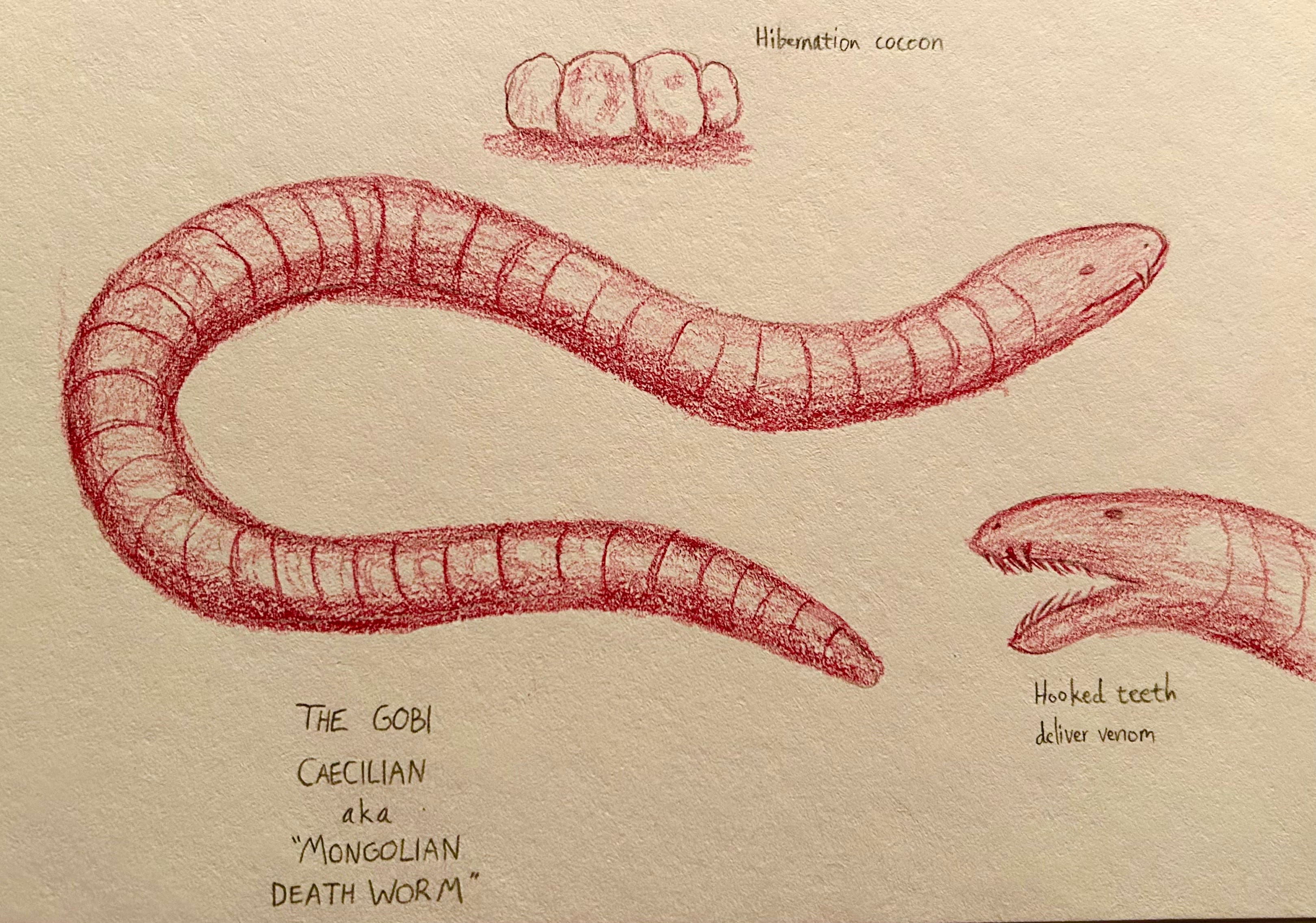
The white sphere’s contents had spilled out in something like a red, slimy mass. Admittedly his mental picture was of some large worm, but when he got a closer look at where the bear had bitten it in half, he could see white bone.
Vertebrae? What on God’s green Earth …?
Movement drew his gaze back to the hole. A few of the white orbs twitched or rattled against the others. One orb broke open, and something lashed out at his ankle. He yelped at a sharp pain and kicked out of reflex. He tried to step back, but loose gravel gave way under his shoe and he fell on his backside.
A red worm had fastened to his sock like a disgusting lamprey. He tried to shake it off, but the thing held on tight, flopping around. He had to keep whatever it was from breaking the skin in case it was venomous, so he risked a firm grip on its slimy body just behind the head. He could see two small eyes, almost vestigial and covered in a thin layer of skin.
Carefully, he worked to pry the mouth off the fabric of his sock. Translucent fangs snagged on the threads until he pulled it away. Keeping a grip behind its head, he jammed the creature sharply against a stone, shattering its head with a wet smack.
He’d killed it.
Fangs? On a worm?
The brief observation vanished as an electric spasm of agony shot up his arm, like someone had jammed a taser into his entire nervous system. The pain hit him so hard, Dominic couldn’t even scream. He fell back, his body locking up. His brain allowed him no more motion, not even to get away from the creature. The dead thing slipped out of his hand.
Was he having a heart attack? No. The creature that could not—should not—exist must have been toxic through its skin as well, like a poison dart frog. He heard something metal and heavy hit the ground with a clunk. His thermos of hot water for his tea.
“Sir!” Baatar came running to Dominic, giving the dead worm a wide berth.
It took effort to push the words out through his locked teeth. “Don’t touch. Toxin … in skin.” Whatever it was, Dominic expected his heart to stop at any moment. Every sound became louder, rattling in his ears. Even his own stilted breathing sounded like nails on a chalkboard.
With careful hands, Baatar grabbed Dominic under his arms and dragged him away from the hole. His foot bumped the metal thermos, and that noise cut into Dominic’s mind like a knife.
Wait. The thermos. Hot water could denature toxic proteins. It worked for jellyfish stings, at least. He had no idea if it would work. But he had to try. Maybe he would at least live a little longer.
“Hot water!” he said. Or at least tried to say. “Thermos! Open it!”
“What, sir?” Baatar said.
“Hot water. On … hand!” Was the man able to understand him? Dominic’s own voice was painful to hear. But Baatar picked up the thermos, came back to stand over him, and unscrewed the lid. Maybe Dominic spoke more clearly than his own ears implied.
Intense heat spilled over his hand, and Dominic cried out. The flow stopped. “No! Keep pouring! Don’t waste it!”
Baatar did so, and as the stream of hot water resumed, Dominic could feel the electric pain ebbing away. He could breathe a little easier. The effort to speak sapped him harder than expected. The world pulled away from him, Bataar’s shouts dwindling to a faint echo, then all fell to darkness.
#
Searing bright light drove through Dominic’s retinas. He shut his eyes. Sullen soreness weighed down every cubic inch of his body. But it surprised him that he still had a body.
That creature, that impossible worm with vertebrae and fangs, had tried to bite him. Had anything gotten into his bloodstream?
He lay atop taut fabric. A cot. Folding tables loaded with fossils stood next to him. Overhead, spectacular stars filled the night sky. A couple of portable lanterns lit up the area. Dr. Berg stood over him, shining a flashlight into his eyes, with Baatar looking over Berg’s shoulder.
As if from miles away, he heard the yowls and grunts of a bear cub.
“Your furry little friend is okay,” Dr. Berg said. “Baatar here saved your life. We can’t tell for sure, but it looks like you got a light dose of that toxin. Seems to hit humans differently than bears.”
Baatar leaned forward, a cigarette dangling from his lips. “How’s that for a myth?” he said with a sardonic laugh.
Trying to move his head, Dominic got another stab of pain through his temples.
“Easy there,” Dr. Berg said. “I think the toxin is working its way out of your system. My best guess is the creature wasn’t fully awake, and it just reacted to protect itself. Minor abrasions on your ankle, but the teeth didn’t break through.”
Nodding gingerly, Dominic forced himself to speak through the headache. “Yeah. They looked like your fossil eggs. Or cocoons of some type.”
“My money’s on cocoons,” Berg said. “I got a look at that nest, too, just a few minutes ago. They kinda reminded me of lungfish. Those can secrete a mucus cocoon to lock moisture in, and they stay underground for years.”
Dominic fixed him with a stare. “Did you know about these things?”
Berg shook his head. “We got the one you killed in a plastic bag. Soon as we can find some ethanol, we’ll preserve it. Don’t worry, I’m not taking credit for the discovery. It’s all yours.”
Baatar flicked the cigarette away. “This lucky idiot. Only man I know who’s survived Olgoi-khorkhoi.”
“Go easy on him, Baatar. I thought it was just a myth too. Just hadn’t seen one until now.”
Dominic’s right arm struggled to reach the edge of the cot. There was a tremor, but he tested his hand by touching his thumb to all his other fingers. “My phone. I need my phone.”
Baatar nodded and reached into Dominic’s shirt pocket, handing over his smartphone.
Sitting up, Dominic groaned as his head throbbed. “We need pictures of that animal.”
“Take it easy.” Baatar put a hand on his shoulder. “You’re not ready to walk. Here.” He moved somewhere Dominic couldn’t see, and returned with a large plastic bag containing what looked like a red intestine, well over a foot long. The creature looked even more repulsive up close. The head was half smashed, but Dominic could see the broken jaws poking through shredded tissue, and sharp needlelike teeth straight out of a monster movie. He hadn’t been hallucinating. And there were those fading eyes, as if the creature was evolving away from needing sight. Two sensory appendages on the muzzle looked like short versions of catfish whiskers.
Dominic turned on the flashlight on his phone and held it up to the bag, looking at every detail he could. The eyes and teeth, the vertebrae he’d seen on the other creature half-eaten by their dead bear …
The animal seemed familiar to him. “It’s definitely not a worm,” Dominic said. Wrong clade. It’s a vertebrate.”
“I wondered about a legless lizard at first,” Berg said, “but it doesn’t have external ear openings.”
“I know a guy who can give us something more specific.” He tapped the phone, going into his contacts to find the right name: Dr. Nolan Douglas, Herpetologist, UW. One of his colleagues at the University of Washington.
After Baatar helped him take some photos, Dominic painstakingly typed a text, trying to be as specific as possible:
ID? Burrowing creature at Flaming Cliffs. Emerged from cocoon like lungfish. Legless lizard? Venomous. Toxin absorbed through skin, denatured with hot water. I’ll send coordinates when we can talk.
He hit the Send button, hoping Nolan would get back to him soon.
“If your contact cannot help us, who do you want me to call?” Baatar’s leathery hands folded together, and he sat down in a camping chair with a quiet heaviness.
“Next of kin would be a good idea,” Dr. Berg said. “Just in case.”
“I’m not dying,” Dominic said. “We’ve still got a bear to take care of.”
Baatar nodded. “I’m caring for it too. I orphaned him.”
“Don’t blame yourself, Bataar,” Dominic said. “I should’ve listened to you. You saved my life.”
Shrugging, Bataar pointed at his hands. “Fast thinking, to try the hot water. Other men died quick. That’s what my grandmother said.”
The phone rang. That was fast, Dominic thought, accepting the call.
Nolan Douglas’s deep voice thundered all the way from Washington. “What is this, Dom? Some kind of prank? I’m flying out to Cameroon in the morning, so this better not be some—”
“No.” He coughed. “No, it’s real. Here, I’ll put you on speaker.” He tapped the phone so Baatar and Dr. Berg could hear him. Berg filled Nolan in, Dominic adding details as he could.
Dr. Douglas cleared his throat. “All right. Good news and bad news. Which do you want first?”
Dominic coughed again. “Good first. I’ve had a rough night.”
“Sounds like it.” Nolan took a deep breath. “Okay, good news. I know what this is. The small sensory tentacles on the snout give it away.”
Nolan spoke a name, but in his torpor, Dominic didn’t quite catch it. It sounded like Sicilian. “It came from Sicily?” he said, fighting the desire to fall asleep and maybe, just maybe, never wake up.
“No,” Nolan said, “the name’s phonetically similar. The technical term is caecilian. It’s a type of amphibian.”
At last, his toxin-fatigued brain latched onto the title. “That’s the term. Rings a bell, but from way back in college.” He heard the weariness in his own voice, and willpower was the one resource he could draw on to keep his body from sliding back to unconsciousness.
“They’re pretty obscure,” Nolan said, a tremor of worry straining his words. “Dom, are you okay? Can you get to a hospital where you are?”
“Just tell me,” Dominic said, clutching the phone tight. “Are caecilians toxic?”
“Yeah, they can be. That’s the bad news. That was discovered only a few years ago. Nasty teeth, too. If it bit you, I’d check for anticoagulants in your blood.”
“Almost got me. But no. I didn’t get bitten. The problem was skin absorption.” He glanced at Baatar. “A local guide saved my life with hot water, after I’d grabbed this … caecilian to get it off me. So wear gloves if you get to examine one.”
“Once I get back from Africa. Sounds like a plan.”
Dominic noticed Nolan’s voice sounded hollow and somehow farther away. But he clung all the tighter to hope. How warranted was that hope? “These caecilians—are any of them desert-dwellers?”
“No, all of the known species are tropical. Something like that in the Gobi Desert could burrow deep where there’s more moisture, but it would still need to evolve a water-retentive skin. First time for everything, I guess.”
“This thing was in a mucus cocoon. There were a cluster of them in some kind of lair. I think we should collect them for study. We recently had a flash flood, so I’m thinking they’re emerging to mate.” Amphibians were not his specialty, but he knew African bullfrogs would lie dormant in deserts or savannas to wait for the rains.
A brief silence on the other end. Dominic could practically hear the gears turn in Dr. Douglas’s head. “Speculation, but we’ll go with that. I remember hearing rumors about some kind of Death Worm in the Gobi.”
“You said these are obscure,” Dominic said. “But there’s gotta be something about this thing in the literature, right? Something other than legends, I mean.” Dominic could hardly accept the notion that such a creature spent all this time evading discovery, no matter how deep it normally burrowed.
“Nope,” Nolan said. “Not a thing, Dom. You’ve found a new species. I think congratulations are in order. We’ll make it official later. Just focus on getting better so you can enjoy it, okay?”
Dominic managed a faint laugh. “I’ll give it my very best shot. I’ll send coordinates and message you tomorrow.” And he promised himself he would be alive tomorrow to make that call. “It’s a lot to take in, but at least I can help give a bear cub a new home.”
He gazed up at the glittering stars, which seemed oddly brighter and closer, as if his eyesight had sharpened. Perhaps the world still held a couple of surprises after all.
About the Author
John K. Patterson is the creator of the Arrivers and Queensland Crater universes. A self-trained author and artist who takes his monsters way too seriously, he can usually be found haunting the local coffee shop while working on his novels. He lives at the roots of Pikes Peak in Colorado Springs, Colorado.